
The Recall System: Every Healthcare Practice Needs to Stop Losing Patients
Why the biggest growth opportunity in your practice isn't finding new patients it's remembering the ones you already have.
Every healthcare practice is working toward the same goals: attracting more patients, filling more appointments, earning more referrals, and growing sustainably.
To make that happen, practices invest in advertising, improve their websites, encourage online reviews, and spend thousands of dollars attracting new patients through marketing campaigns.
Those efforts are important.
But they often distract from a much bigger question.
What happened to the patients who were supposed to come back?
Not the patient who completed treatment.
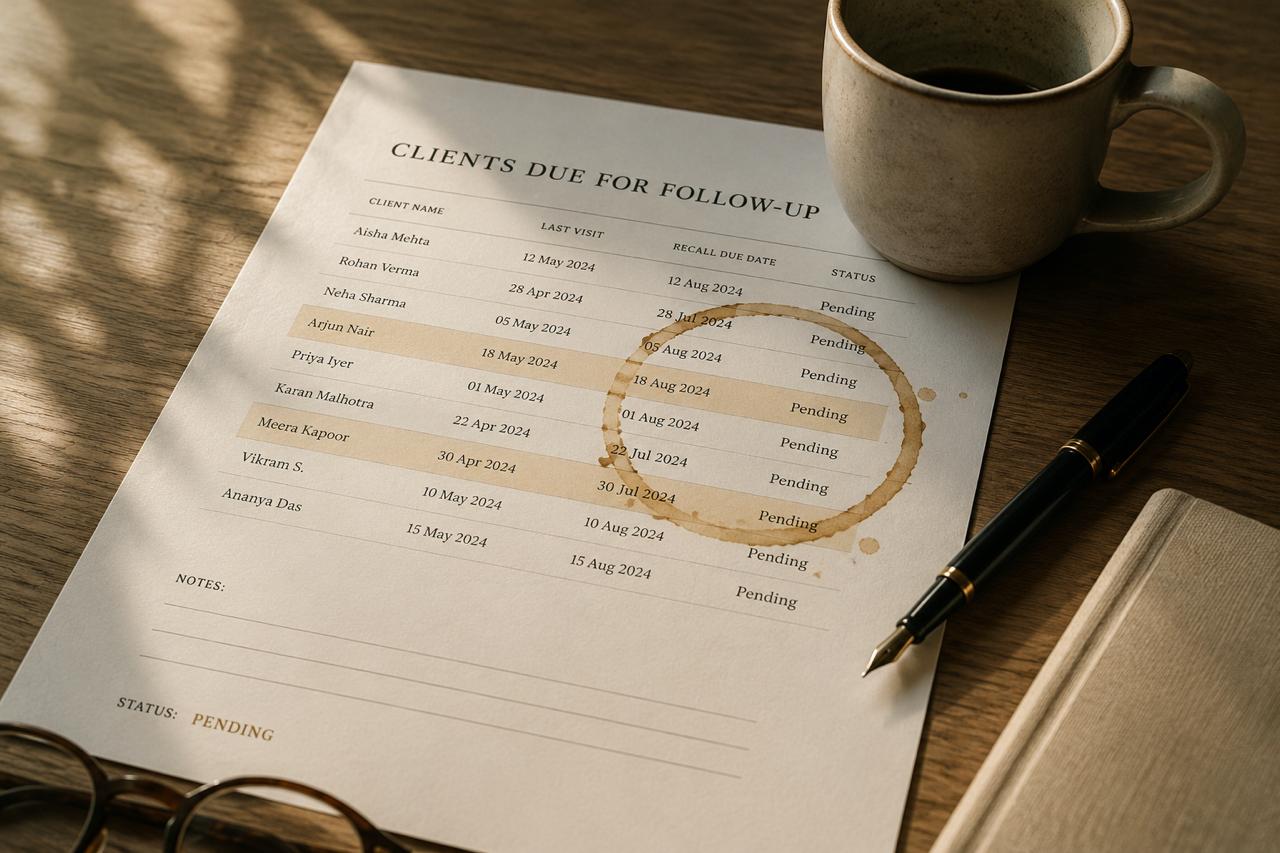
The patient who never returned for their six-month dental review.
The physiotherapy patient who stopped attending after three sessions because the pain had improved "just enough."
The dermatologist's patient who never booked their annual skin review.
The optometry patient who forgot it was time for another eye examination.
The nutrition client who fully intended to continue but got caught up in everyday life.
These aren't patients who left because your care wasn't good enough.
More often than not, they're patients who quietly disappeared because nobody reached out.
For many healthcare practices, that's one of the biggest and least visible sources of lost revenue.
The Silent Patient Leak
Imagine carrying water in a bucket with a small crack at the bottom.
Every day you pour more water into it.
Every day, a little leaks out.
Instead of repairing the crack, you simply keep adding more water.
That is how many healthcare practices approach growth.
They continuously invest in attracting new patients while existing ones quietly drift away.
The leak usually isn't your clinical expertise.
It isn't your pricing.
It isn't even the competition down the road.
Most of the time, the leak is silence.
Patients rarely make a conscious decision never to return.
Life simply gets in the way.
Work becomes busy. Children need attention. Holidays come around. Health concerns improve just enough to feel less urgent. Before long, the appointment they intended to schedule is forgotten.
Weeks become months.
Months become years.
Without a structured recall system, patients gradually disappear not because they didn't value your care, but because nobody reminded them it was time to continue it.
Healthcare Practices Remember. Patients Don't.
Your practice remembers almost everything.
- When a patient last visited.
- What treatment they received.
- What concerns were discussed.
- What follow-up care was recommended.
- When they should ideally return.
Your patients don't.
Not because they don't care.
Because they're human.
Healthcare simply isn't at the front of most people's minds every day.
People remember tomorrow's work meeting before they remember their routine dental cleaning.
They remember school pick-up before their posture review.
They remember birthdays before they remember their annual eye examination.
That's not negligence.
It's simply how life works.
The problem begins when practices expect patients to remember information the practice already knows.
Human memory has never been a reliable recall strategy.
Systems are.
A Reminder Isn't a Recall
These two terms are often used interchangeably.
They shouldn't be.
A reminder supports an appointment that's already been booked.
"Your appointment is tomorrow at 10:00 AM."
A recall creates the next appointment before the patient quietly disappears.
"It's been six months since your last visit. Based on your treatment plan, it's time to schedule your next review."
One protects today's schedule.
The other protects tomorrow's patient relationships.
That distinction matters.
Appointment reminders help reduce no-shows.
Recall systems ensure patients continue receiving the care they need over months and years.
The Cost of Missed Follow-Ups
When a patient doesn't return, the first thing most practices notice is an empty appointment slot.
But that's only part of the story.
Every missed follow-up creates a ripple effect.
A routine dental review that never happens can allow a minor issue to develop into major treatment.
A physiotherapy patient may stop rehabilitation before fully recovering.
A skin condition may go unmonitored.
A nutrition plan may lose momentum.
A long-term wellness journey may quietly come to an end.
The financial cost is obvious.
The clinical impact is often far greater.
Healthcare has never been about a single appointment.
It's about supporting patients throughout their journey.
Without a structured recall process, that continuity begins to break.
Your Patient Database Is More Valuable Than You Think
Most practices spend considerable time and money trying to attract new patients.
Yet one of their most valuable assets is already sitting inside their practice management software.
Their existing patient database.
These patients already know your practice.
They've already trusted your clinicians.
They've already experienced the quality of your care.
You've already invested time, effort, and resources into building that relationship.
Re-engaging an existing patient is often easier and significantly more valuable than constantly competing for someone completely new.
The objective isn't to stop attracting new patients.
It's to stop forgetting the ones you've already earned.
Great Recall Systems Don't Depend on Memory
Many practices still rely on manual processes.
Sticky notes.
Reception staff remembering who needs a phone call.
Colour-coded spreadsheets.
Calendar reminders.
Handwritten follow-up lists.
These systems often work for a while.
Until they don't.
Reception becomes busy.
The phones keep ringing.
A team member goes on leave.
Priorities shift.
The list gets forgotten.
And eventually, so do the patients.
The most successful healthcare practices don't rely on individual memory.
They rely on repeatable systems.
Every patient who requires follow-up is identified.
Every recall is tracked.
Every opportunity to reconnect is captured.
Because consistency not good intentions is what keeps patients engaged over time.
The Recall Advantage
The practices that experience steady, long-term growth aren't always the ones with the largest advertising budgets.
They're the ones that consistently build relationships.
They understand that healthcare doesn't end when a patient walks out the door.
It continues through follow-up.
Preventive care.
Regular reviews.
Ongoing communication.
Patients feel genuinely cared for when their healthcare provider remembers them even when they forget themselves.
That's the point where a recall system becomes more than an administrative process.
It becomes part of the patient experience itself.
Smarter Practices Are Automating Their Recall Systems
Healthcare teams are busier than ever.
Expecting reception staff to manually monitor every recall, overdue patient, and follow-up simply isn't realistic anymore.
That's why more healthcare practices are moving toward intelligent recall automation.
Instead of relying on spreadsheets or memory, platforms like SmilePing automatically identify patients who are due for follow-up, send personalised recall messages at the right time, and help re-engage patients who may have quietly drifted away.
The goal isn't to send more messages.
It's to make sure every patient receives the right message at the right moment without creating additional work for your team.
The result is better patient retention, stronger continuity of care, healthier patient relationships, more predictable practice growth, and fewer patients slipping through the cracks.
Final Thought
Before you increase your advertising budget...
Before you launch your next marketing campaign...
Before you ask how to attract more patients...
Take a moment to open your patient database.
Look at the people who have already trusted your practice.
Then ask yourself one simple question.
How many of them intended to come back but simply never did because nobody reached out?
The answer may represent thousands of dollars in lost revenue.
More importantly, it may represent patients whose care was unintentionally interrupted.
The healthcare practices that thrive over the next decade won't simply be the ones that attract the most new patients.
They'll be the ones that consistently care for the patients they already have.
Because great healthcare isn't just about delivering excellent treatment.
It's about making sure no patient is forgotten.